Dr. Phorramatpanyaprat Tongprasong
Conceptualization, Synthesis, and Strategic Design
1. Strategic Imperative
Higher education is undergoing a structural shift—from knowledge delivery to capability activation and societal impact. Universities that remain content-centric risk declining relevance, while those that activate learning into real-world value become national and global leaders.
Suan Dusit University is uniquely positioned to lead this transformation through the concept of:
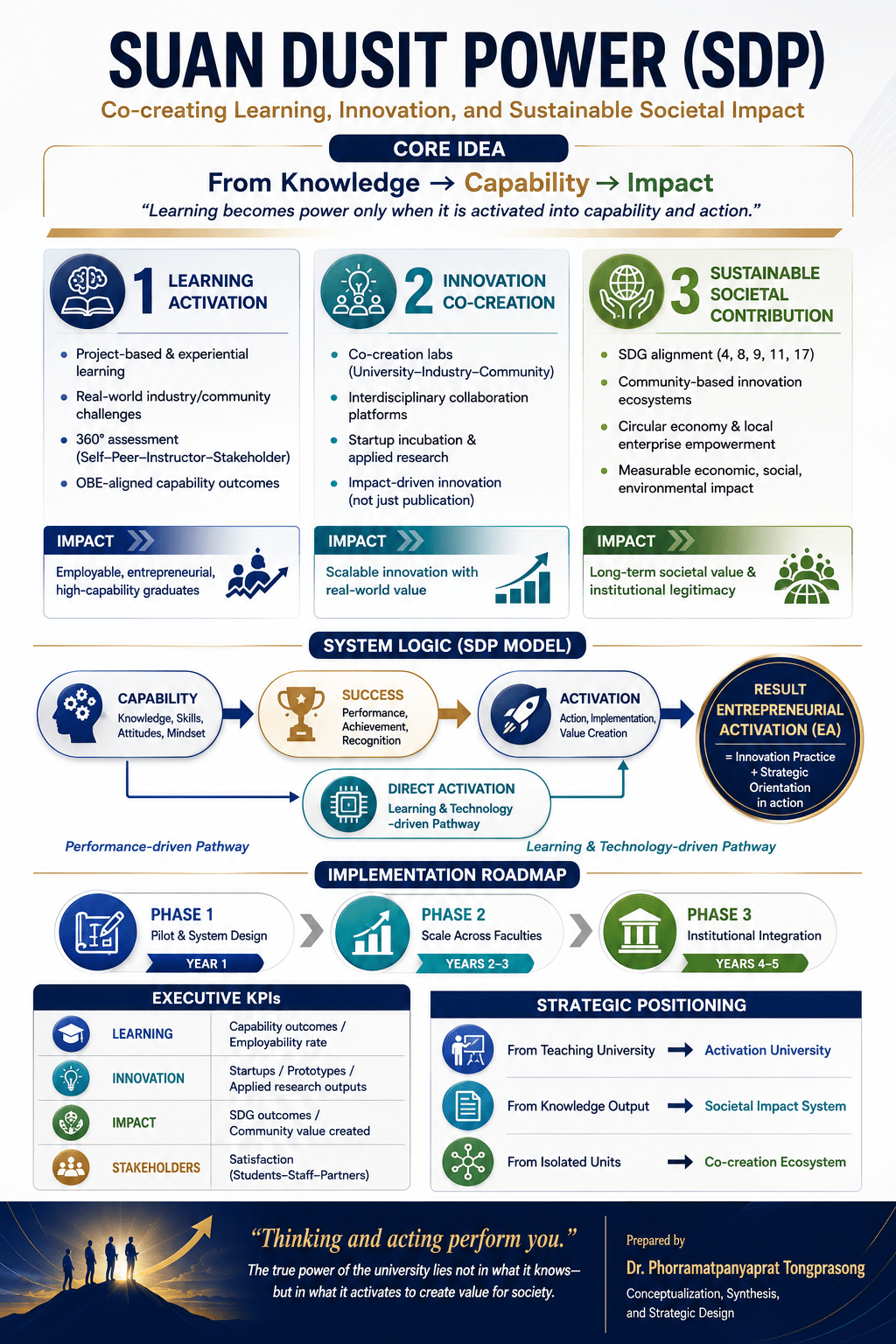
“Suan Dusit Power (SDP): The collective capability of the university ecosystem to activate learning, co-create innovation, and deliver sustainable societal value.”
This policy brief proposes SDP as a strategic institutional model aligned with:
- Outcome-Based Education (OBE)
- AUN-QA Version 4
- National innovation and sustainability agendas
- Global frameworks (SDGs, impact-driven education)
2. Policy Goal
To transform Suan Dusit University into an Activation University that:
- Converts learning into capability and performance
- Translates innovation into real-world value
- Delivers measurable societal impact sustainably
3. Strategic Pillars (SDP Framework)
Pillar 1: Learning Activation
Shift: From “knowing” → to “doing and performing”
Key Actions:
- Embed project-based, experiential learning across all programs
- Integrate real-world problems (industry/community) into coursework
- Implement 360-degree assessment (student–peer–faculty–stakeholder)
- Align CLOs with capability-based outcomes (OBE)
Expected Impact:
- Graduates with high employability and entrepreneurial capability
- Evidence-based learning outcomes (beyond GPA)
Pillar 2: Innovation Co-creation
Shift: From isolated research → to ecosystem innovation
Key Actions:
- Establish Co-creation Labs (faculty–students–industry–community)
- Promote interdisciplinary innovation platforms
- Support startup incubation and applied research
- Incentivize impact-oriented outputs (not only publications)
Expected Impact:
- Scalable innovation with real societal relevance
- Strong university–industry–community integration
Pillar 3: Sustainable Societal Contribution
Shift: From service → to long-term impact systems
Key Actions:
- Align all initiatives with SDGs (4, 8, 9, 11, 17)
- Develop community-based innovation ecosystems
- Implement impact measurement frameworks
- Promote circular economy and local enterprise empowerment
Expected Impact:
- Measurable economic, social, and environmental value
- Strengthened institutional legitimacy and trust
4. Implementation Model
4.1 Governance Structure
- SDP Steering Committee (University-level policy & direction)
- Faculty Activation Units (program-level implementation)
- External Advisory Board (industry & community alignment)
4.2 Phased Roadmap
| Phase | Focus | Timeline |
| Phase 1 | Pilot Programs & System Design | Year 1 |
| Phase 2 | Scaling Across Faculties | Years 2–3 |
| Phase 3 | Institutional Integration | Years 4–5 |
4.3 Enabling Systems
- Digital platform for learning–innovation–impact tracking
- Incentive systems for faculty/student engagement
- Integrated curriculum–research–service architecture
5. Key Performance Indicators (KPIs)
| Dimension | Indicator |
| Learning | Capability-based outcomes / employability rate |
| Innovation | Prototypes, startups, applied research outputs |
| Impact | Community outcomes / SDG alignment |
| Stakeholders | Satisfaction (students, staff, partners) |
6. Strategic Value to the University
Institutional Transformation
- From Teaching University → Activation University
- From Output-driven → Impact-driven
AUN-QA Alignment
- Criterion 1–8: Strong alignment in OBE, stakeholder engagement, CQI
- Evidence-based outcomes for accreditation excellence
Competitive Advantage
- Distinct institutional identity: “University of Activation and Impact”
- Enhanced global positioning and partnerships
7. Risks and Mitigation
| Risk | Mitigation |
| Resistance to change | Capacity building & leadership alignment |
| Fragmented implementation | Central governance + integrated systems |
| Lack of impact measurement | Develop standardized impact metrics |
Concluding Statement
“Suan Dusit Power” is not an initiative—it is a transformation.
It redefines the university as a system were thinking and acting converge to create value.
By adopting SDP, Suan Dusit University will not only educate—but activate, innovate, and transform society sustainably.
92 ปีร่วมสร้างสรรค์ “พลังสวนดุสิต” เพื่อขับเคลื่อนคุณค่าแห่งการเรียนรู้ นวัตกรรม และการสร้างคุณูปการต่อสังคมอย่างยั่งยืน
1. บริบทเชิงยุทธศาสตร์ (Strategic Imperative)
การอุดมศึกษากำลังเผชิญการเปลี่ยนผ่านเชิงโครงสร้าง จากรูปแบบที่เน้น การถ่ายทอดความรู้ (knowledge delivery) ไปสู่รูปแบบที่มุ่ง การกระตุ้นศักยภาพ (capability activation) และการสร้าง ผลกระทบต่อสังคม (societal impact) อย่างเป็นรูปธรรม
สถาบันอุดมศึกษาที่ยังคงยึดติดกับการเรียนการสอนแบบเน้นเนื้อหา (content-centric) มีแนวโน้มสูญเสียความสามารถในการแข่งขัน ขณะที่สถาบันที่สามารถแปลงองค์ความรู้ไปสู่การปฏิบัติจริง จะก้าวขึ้นเป็นผู้นำในระดับชาติและนานาชาติ
มหาวิทยาลัยสวนดุสิตมีศักยภาพเชิงยุทธศาสตร์ในการขับเคลื่อนการเปลี่ยนแปลงดังกล่าว ผ่านแนวคิด:
“พลังสวนดุสิต (Suan Dusit Power: SDP)” คือ ศักยภาพเชิงระบบของมหาวิทยาลัยในการบูรณาการและกระตุ้นการเรียนรู้ การร่วมสร้างนวัตกรรม และการสร้างคุณค่าให้แก่สังคมอย่างยั่งยืน
แนวทางนี้สอดคล้องกับกรอบสำคัญ ได้แก่
- การจัดการศึกษาที่มุ่งผลลัพธ์ (Outcome-Based Education: OBE)
- เกณฑ์คุณภาพ AUN-QA Version 4
- นโยบายระดับชาติด้านนวัตกรรมและความยั่งยืน
- กรอบการพัฒนาระดับโลก (SDGs)
2. เป้าหมายเชิงนโยบาย (Policy Goal)
เพื่อยกระดับมหาวิทยาลัยสวนดุสิตสู่การเป็น
“มหาวิทยาลัยแห่งการขับเคลื่อนศักยภาพ (Activation University)”
โดยมีเป้าหมายหลักดังนี้
- แปลงการเรียนรู้ให้เป็น สมรรถนะและผลการปฏิบัติงานจริง
- แปลงนวัตกรรมให้เป็น คุณค่าเชิงเศรษฐกิจและสังคม
- สร้าง ผลกระทบต่อสังคมที่วัดผลได้อย่างยั่งยืน
3. กรอบยุทธศาสตร์ (Strategic Pillars: SDP Framework)
เสาหลักที่ 1: การขับเคลื่อนการเรียนรู้สู่ศักยภาพ (Learning Activation)
การเปลี่ยนผ่าน: จาก “การรู้” → สู่ “การปฏิบัติและการสร้างผลงาน”
แนวทางดำเนินการ:
- บูรณาการการเรียนรู้แบบโครงงานและประสบการณ์จริงในทุกหลักสูตร
- เชื่อมโยงปัญหาจริงจากภาคอุตสาหกรรมและชุมชนเข้าสู่กระบวนการเรียนรู้
- ใช้ระบบการประเมินแบบรอบด้าน (360 องศา)
- เชื่อมโยงผลลัพธ์การเรียนรู้รายวิชา (CLOs) กับสมรรถนะเชิงปฏิบัติ (OBE)
ผลลัพธ์ที่คาดหวัง:
- บัณฑิตที่มีความสามารถในการทำงานสูงและมีศักยภาพเชิงผู้ประกอบการ
- ผลลัพธ์การเรียนรู้ที่ตรวจสอบได้เชิงประจักษ์ (beyond GPA)
เสาหลักที่ 2: การร่วมสร้างนวัตกรรม (Innovation Co-creation)
การเปลี่ยนผ่าน: จากการวิจัยแบบแยกส่วน → สู่ระบบนิเวศนวัตกรรมแบบบูรณาการ
แนวทางดำเนินการ:
- จัดตั้ง ห้องปฏิบัติการร่วมสร้าง (Co-creation Labs)
- ส่งเสริมความร่วมมือข้ามศาสตร์
- สนับสนุนการบ่มเพาะธุรกิจและงานวิจัยเชิงประยุกต์
- ปรับระบบแรงจูงใจสู่ ผลลัพธ์ที่สร้างผลกระทบจริง
ผลลัพธ์ที่คาดหวัง:
- นวัตกรรมที่สามารถขยายผลได้จริง
- ความเข้มแข็งของความร่วมมือระหว่างมหาวิทยาลัย–อุตสาหกรรม–ชุมชน
เสาหลักที่ 3: การสร้างคุณูปการต่อสังคมอย่างยั่งยืน (Sustainable Societal Contribution)
การเปลี่ยนผ่าน: จาก “การบริการวิชาการ” → สู่ “ระบบสร้างผลกระทบระยะยาว”
แนวทางดำเนินการ:
- เชื่อมโยงกับเป้าหมายการพัฒนาที่ยั่งยืน (SDGs)
- พัฒนาระบบนิเวศนวัตกรรมฐานชุมชน
- สร้างระบบวัดผลกระทบ (impact measurement)
- ส่งเสริมเศรษฐกิจหมุนเวียนและผู้ประกอบการท้องถิ่น
ผลลัพธ์ที่คาดหวัง
- คุณค่าเชิงเศรษฐกิจ สังคม และสิ่งแวดล้อมที่วัดได้
- ความเชื่อมั่นและความชอบธรรมของสถาบัน
4. รูปแบบการดำเนินการ (Implementation Model)
โครงสร้างการกำกับดูแล
- คณะกรรมการขับเคลื่อน SDP ระดับมหาวิทยาลัย
- หน่วยปฏิบัติการระดับคณะ (Activation Units)
- คณะกรรมการที่ปรึกษาภายนอก
แผนการดำเนินงานแบบระยะ
- ระยะที่ 1: ออกแบบระบบและโครงการนำร่อง (ปีที่ 1)
- ระยะที่ 2: ขยายผลระดับคณะ (ปีที่ 2–3)
- ระยะที่ 3: บูรณาการทั้งมหาวิทยาลัย (ปีที่ 4–5)
ระบบสนับสนุน
- แพลตฟอร์มดิจิทัลติดตามผลการเรียนรู้–นวัตกรรม–ผลกระทบ
- ระบบแรงจูงใจสำหรับอาจารย์และนักศึกษา
- โครงสร้างบูรณาการหลักสูตร–วิจัย–บริการวิชาการ
5. ตัวชี้วัดความสำเร็จ (Key Performance Indicators)
- ด้านการเรียนรู้: สมรรถนะบัณฑิต / อัตราการมีงานทำ
- ด้านนวัตกรรม: จำนวนต้นแบบ ธุรกิจใหม่ งานวิจัยประยุกต์
- ด้านผลกระทบ: ผลลัพธ์ต่อชุมชน / SDG alignment
- ด้านผู้มีส่วนได้ส่วนเสีย: ระดับความพึงพอใจ
6. คุณค่าเชิงยุทธศาสตร์ต่อมหาวิทยาลัย
- การเปลี่ยนผ่านสู่ มหาวิทยาลัยแห่งการขับเคลื่อนศักยภาพ
- การยกระดับสู่ระบบ Impact-driven University
- การสอดคล้องเกณฑ์ AUN-QA อย่างเป็นระบบ
- การสร้างปรากฏการณ์สำคัญคือ
“มหาวิทยาลัยแห่งการสร้างคุณค่าและผลกระทบต่อสังคม”
ข้อสรุป
“พลังสวนดุสิตไม่ใช่โครงการ แต่คือการเปลี่ยนผ่านเชิงระบบ”
แนวคิดนี้กำหนดบทบาทใหม่ของมหาวิทยาลัยในฐานะ
แพลตฟอร์มที่เชื่อมโยงการคิดและการลงมือทำ เพื่อสร้างคุณค่าแก่สังคมอย่างยั่งยืน





Leave a Reply