Phorramatpanyaprat Tongprasong, Ph. D. ,FHEA UKPSF
Time as the True Capital of Life
In conventional thinking, capital is often associated with money, assets, or resources. However, the most fundamental and non-renewable form of capital is not what we own—it is time.
Time is not merely a resource to be spent. It is the foundation upon which human existence, capability, and value creation are constructed. Every decision, every action, and every outcome emerges within time and is shaped by how it is used.
Thus, the defining question of life is not:
“What do we have?”
But rather:
“What do we transform our time into?”
Time Cost: The Invisible Cost That Defines Everything
In economics, opportunity cost refers to the value of the next best alternative forgone. In life, however, the concept goes deeper.
Time cost is the loss of unrealized potential.
Every moment allocated to one activity is a moment not invested in another possibility of becoming. Therefore, time is not simply consumed—it is converted into identity, capability, and future outcomes.
In this sense:
Time does not only determine what we do.
It determines who we become.
Life Opportunity: Not Found, But Created
Opportunities are often perceived as external events—something that appears, is recognized, and then seized. However, this perspective is incomplete.
Drawing from the SERVE Framework and the concept of Entrepreneurial Activation (EA), opportunity is not merely discovered—it is constructed through activated capability.
Opportunity is not an event.
It is a process of transformation:
Capability → Action → Performance → Value Creation
The SERVE Perspective: Time as a Catalyst of Activation
Within the SERVE model—comprising Market Capability (MC), Internal Capability (IC), Business Success (BS), and Entrepreneurial Activation (EA)—time plays a critical but often implicit role.
1. Time as the Builder of Capability
- Internal Capability (learning, technology, skills) requires sustained time investment
- Market Capability (understanding value, positioning, customers) emerges through iterative engagement
Without time, capability does not exist.
With misused time, capability does not activate.
2. Time as the Bridge from Success to Activation
Empirical insights suggest that Business Success (BS) is not an endpoint, but a platform for further activation.
Yet, individuals respond to success differently:
- Some use time to preserve stability
- Others use time to expand capability and create new value
This divergence defines the difference between:
Success → Stability
vs.
Success → Entrepreneurial Activation (EA)
3. Time as the Trigger of Entrepreneurial Activation
Entrepreneurial Activation does not arise from ideas alone, nor from resources alone. It emerges from:
Disciplined time allocation toward meaningful action
This directly reflects the core philosophy:
“Thinking and Acting Perform You.”
The Capital of Life Creation Framework
From this synthesis, a unified model emerges:
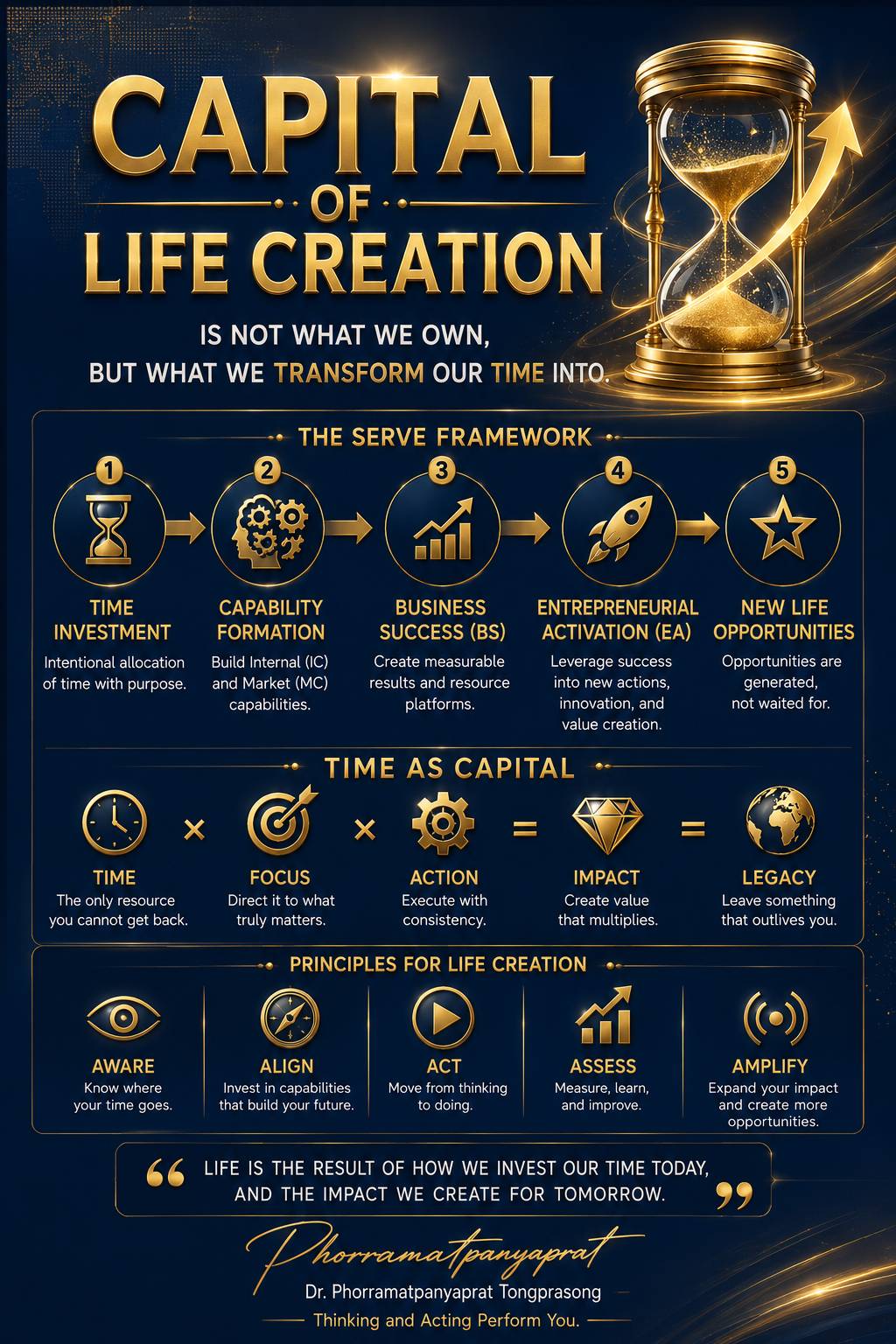
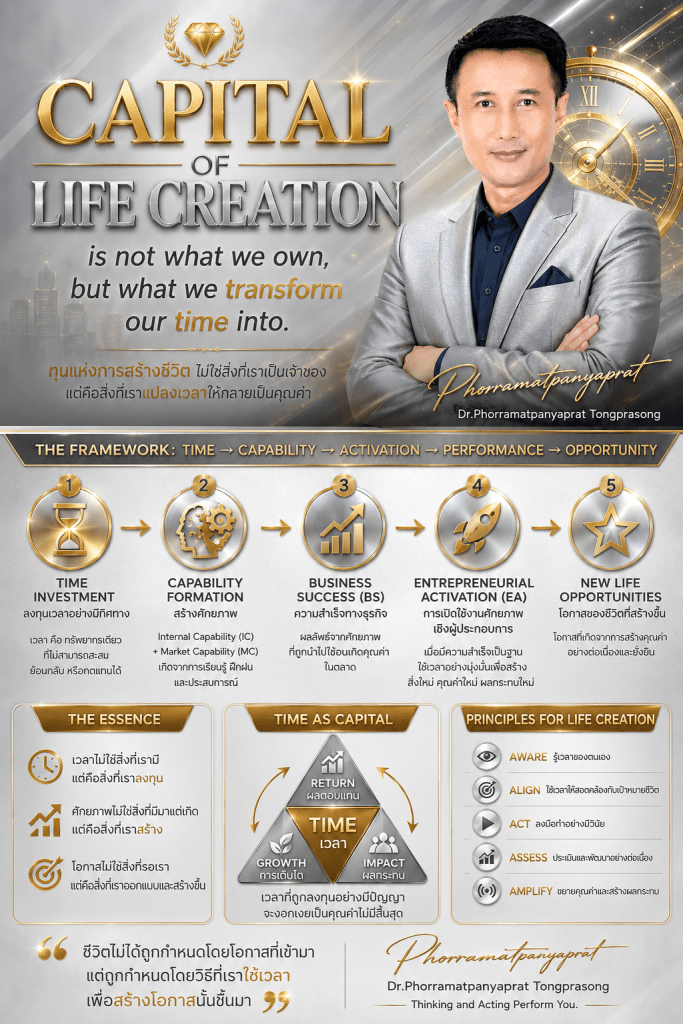
Time Investment → Capability Formation → Activation → Performance → Opportunity Creation
1. Time Investment
Time is intentionally allocated, not passively spent.
2. Capability Formation (IC + MC)
Time is transformed into skills, knowledge, and market understanding.
3. Business Success (BS)
Capabilities generate measurable outcomes and resource platforms.
4. Entrepreneurial Activation (EA)
Success becomes a base for new action, innovation, and value creation.
5. Opportunity Creation
Opportunities are continuously generated—not waited for.
Philosophical Implication: Life as a Function of Time Allocation
At its deepest level, life is not the accumulation of possessions, but the outcome of time transformation.
- Those who spend time consuming become informed
- Those who invest time practicing become skilled
- Those who allocate time to purposeful action become value creators
Life is not what we have.
Life is what we transform our time into.
Practical Principles for Life Creation
To convert time cost into life opportunity:
1. Awareness (Time Audit)
Understand where your time truly goes.
2. Alignment (Strategic Allocation)
Invest time in building meaningful capabilities.
3. Action (Execution Discipline)
Move beyond thinking—act consistently.
4. Assessment (Feedback Loop)
Use performance as a mechanism for continuous improvement.
5. Amplification (Scaling Impact)
Leverage outcomes to create broader value and new opportunities.
Core Proposition
Capital of Life Creation
is not what we own,
but what we transform our time into.
Life is not determined by the opportunities that come to us,
but by how we use our time to create them.
Time is not what we spend.
It is what we convert into capability, action, and performance.
Thinking and Acting Perform You.
Since May 26,2026





Leave a Reply