Reimagining Organizational Performance Through Human-Centered Strategic Management
Phorramatpanyaprat Tongprasong, Ph.D.
In the 21st century, world-class organizations no longer succeed merely because they possess more KPIs, more reports, or more performance indicators. True organizational excellence emerges when strategy, people, competencies, performance systems, and continuous development are connected in a meaningful and balanced way.
Modern organizations are increasingly shifting from traditional bureaucratic management toward what may be called Human Potential-Centered Organizations — organizations that prioritize learning, innovation, adaptability, and sustainable human growth as their core strategic assets.
This transformation reflects a fundamental evolution in human resource management: from controlling labor to developing strategic human capital (Barney, 1991; Becker & Huselid, 2006). Leading global organizations such as Google, Microsoft, and IBM have demonstrated that sustainable success depends not only on systems and technologies, but on the ability to align organizational strategy with human capability development.
Beyond Traditional Performance Management
Traditional performance systems often fail because they focus excessively on documentation, compliance, and numerical control. As a result, employees become risk-averse, innovation declines, and organizations gradually lose agility.
The modern organizational paradigm requires a different mindset.
Instead of asking:
“How can we control people more effectively?”
Organizations should ask:
“How can we unlock human potential more meaningfully?”
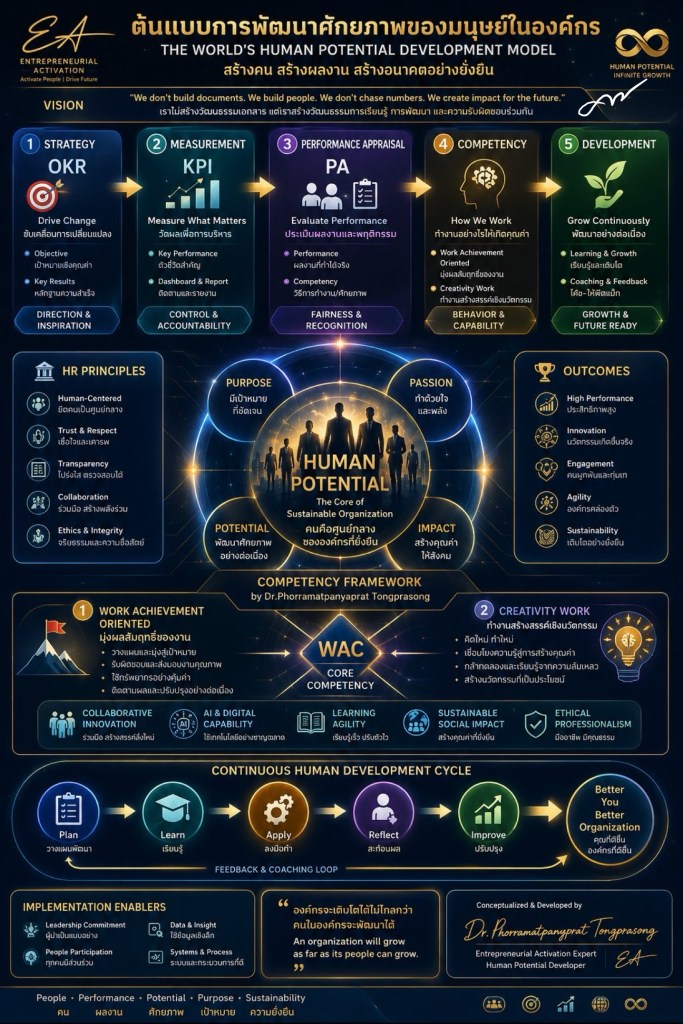
This perspective forms the foundation of the World’s Human Potential Development Model, conceptualized by Dr. Phorramatpanyaprat Tongprasong.
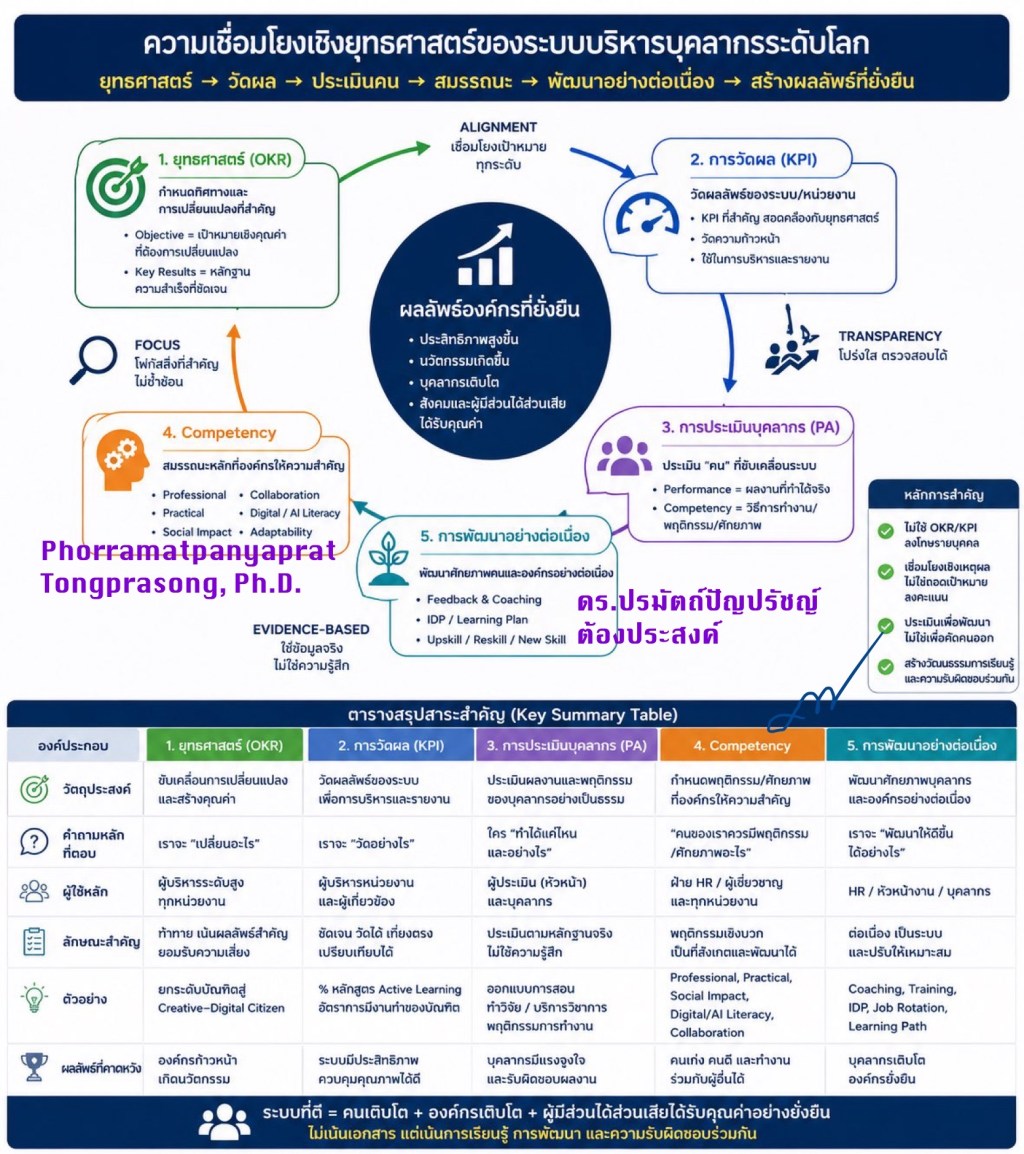
The model proposes that organizational sustainability emerges through the strategic integration of five essential dimensions:
- Strategic Direction (OKR)
- Organizational Measurement (KPI)
- Performance Appraisal (PA)
- Competency Development
- Continuous Human Development
These dimensions must function as an interconnected ecosystem rather than isolated administrative tools.
OKR: Driving Organizational Transformation
Transformation
Objectives and Key Results (OKR) are designed to drive organizational transformation rather than individual punishment.
OKRs define:
- what organizations aim to change,
- what value they seek to create,
- and how progress toward that transformation can be recognized.
According to Doerr (2018), OKRs create focus, alignment, and organizational learning. However, one of the most critical misunderstandings in many organizations is using OKRs as a direct performance punishment mechanism.
When OKRs become instruments of fear:
- employees stop taking risks,
- creativity decreases,
- and innovation cultures collapse.
Therefore, OKRs should inspire direction and experimentation — not fear.
KPI: Measuring What Matters
KPIs remain important because organizations require measurable accountability and operational visibility.
However, KPIs should function as:
- organizational measurement systems,
- strategic dashboards,
- and evidence-based management tools.
They should not reduce human value into numerical scores alone.
Modern KPIs must support:
- transparency,
- strategic decision-making,
- continuous improvement,
- and system accountability.
As Kaplan and Norton (1996) emphasized, effective measurement systems translate organizational strategy into operational reality
Performance Appraisal: Evaluating Both Results and Behaviors
A truly modern Performance Appraisal (PA) system evaluates not only outcomes, but also the quality of human behavior behind those outcomes.
The model separates appraisal into two dimensions:
Performance
What people achieve.
Competency
How people work, collaborate, learn, adapt, and create value.
This distinction is critically important.
Two employees may achieve similar results, but differ significantly in:
- ethical standards,
- collaboration,
- adaptability,
- leadership,
- and innovation capability.
Therefore, organizations must evaluate both achievement and behavioral capability.
The WAC Competency Framework
One of the model’s core innovations is the WAC Competency Framework:
WAC = Work Achievement Oriented & Creativity Work
This framework redefines competency as a balanced integration of:
- performance achievement,
- innovation capability,
- collaborative intelligence,
- digital adaptability,
- and sustainable social impact.
The WAC framework proposes that future-ready organizations require individuals who are:
- achievement-oriented,
- creatively adaptive,
- ethically grounded,
- digitally capable,
- and continuously learning.
In this model, competency is not a checklist.
Competency is:
“Observable human capability that creates meaningful organizational impact.”
From Document Culture to Learning Culture
Many organizations unintentionally create what may be called a document culture:
- excessive reporting,
- bureaucratic evaluation,
- compliance-centered behavior,
- and fear-driven management.
However, sustainable organizations build:
- learning cultures,
- coaching cultures,
- feedback systems,
- and shared responsibility ecosystems.
The future of organizational excellence does not belong to organizations with the most paperwork.
It belongs to organizations that can:
- develop people continuously,
- encourage innovation safely,
- align strategy with human growth,
- and create long-term societal value.
Human Potential as the Core of Sustainability
The central philosophy of this framework is simple:
“An organization will grow only as far as its people can grow.”
Thus, sustainable organizational performance is not merely a function of systems, technology, or metrics.
It is fundamentally a function of:
- human potential,
- shared purpose,
- learning agility,
- collaborative innovation,
- and meaningful development.
Organizations that understand this principle will not merely survive the future.
They will shape it.
References
Aguinis, H. (2019). Performance management (4th ed.). Chicago Business Press.
Armstrong, M., & Taylor, S. (2023). Armstrong’s handbook of human resource management practice (16th ed.). Kogan Page.
Barney, J. (1991). Firm resources and sustained competitive advantage. Journal of Management, 17(1), 99–120.
Becker, B. E., & Huselid, M. A. (2006). Strategic human resources management: Where do we go from here? Journal of Management, 32(6), 898–925.
Doerr, J. (2018). Measure what matters. Portfolio/Penguin.
Kaplan, R. S., & Norton, D. P. (1996). The balanced scorecard: Translating strategy into action. Harvard Business School Press.
World Economic Forum. (2023). The future of jobs report 2023. World Economic Forum.





Leave a Reply