Phorramatpanyaprat Tongprasong, Ph.D.

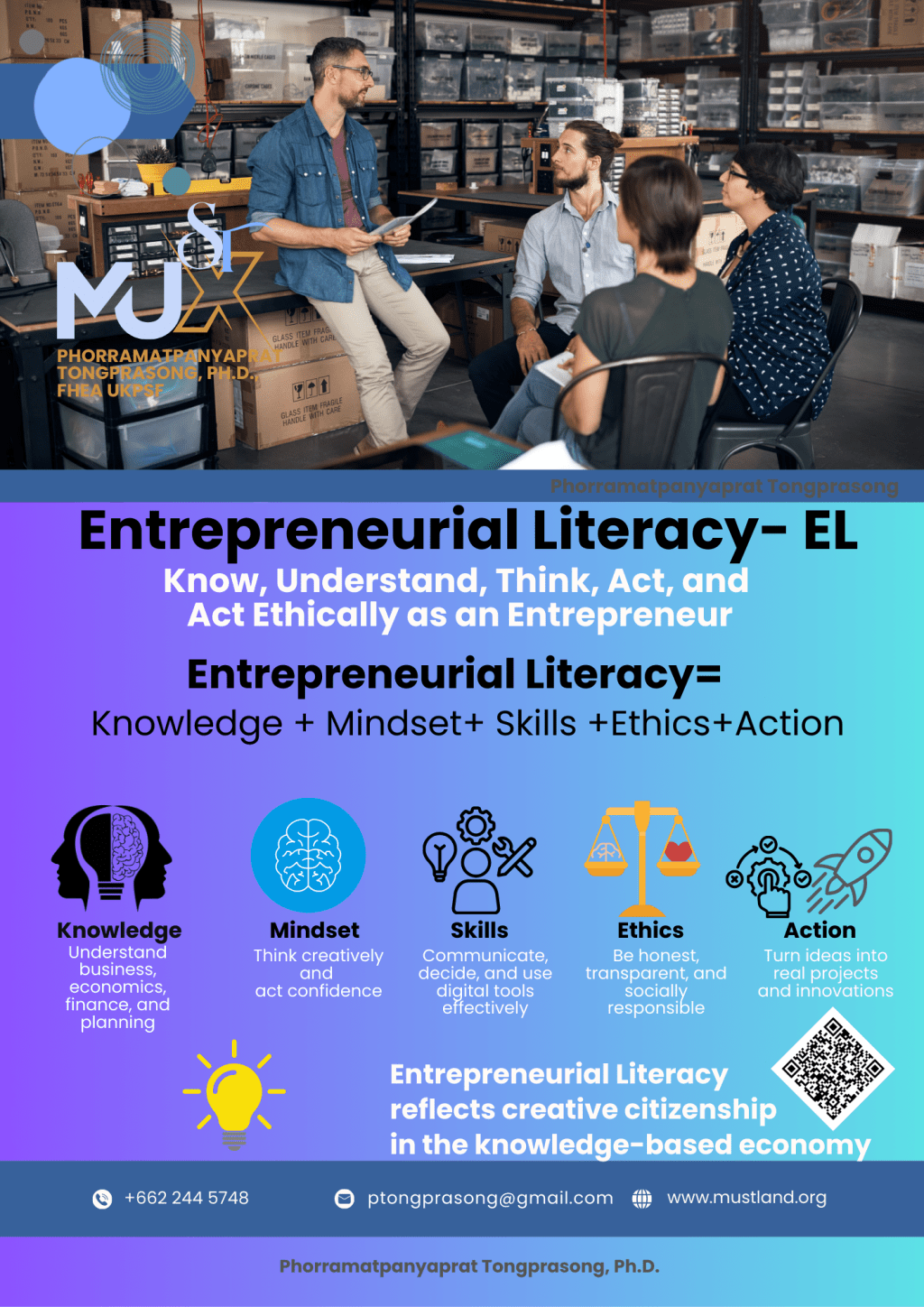
Entrepreneurial Literacy refers to an individual’s ability to understand, analyze, and engage in business activities ethically and responsibly, encompassing dimensions of knowledge, skills, attitudes, and social values (OECD, 2018; UNESCO, 2021). It serves as a fundamental foundation for nurturing “new-generation entrepreneurs” in the knowledge-based economy.
The main components of Entrepreneurial Literacy can be classified into five key dimensions:
(1) Entrepreneurial Knowledge,
(2) Entrepreneurial Mindset,
(3) Entrepreneurial Skills,
(4) Entrepreneurial Ethics and Values, and
(5) Entrepreneurial Action, as described below.
1. Entrepreneurial Knowledge
Entrepreneurial Knowledge refers to a fundamental understanding of business and economic concepts such as business planning, marketing, financial management, and risk management (Hisrich et al., 2020). This knowledge enables learners to identify opportunities and systematically assess business feasibility.
2. Entrepreneurial Mindset
An Entrepreneurial Mindset represents a way of thinking that embraces opportunities and challenges. Its key characteristics include self-efficacy, creativity, resilience, and a willingness to take calculated risks (Rae, 2017). Developing this mindset is vital for inspiring learners to cultivate initiative and proactive entrepreneurial behavior.
3. Entrepreneurial Skills
Entrepreneurial Skills refer to abilities that enable learners to translate ideas into action, such as critical thinking, decision-making, communication, teamwork, and the use of digital technology for innovation (European Commission, 2016; Gibb, 2002). Integrating these skills into learning processes enhances learners’ competencies for success in the modern business world.
4. Entrepreneurial Ethics and Values
This dimension emphasizes moral integrity, honesty, transparency, and responsibility toward consumers, communities, and the environment (Kuratko, 2017). Entrepreneurial ethics serve as a cornerstone for building sustainable growth and earning public trust in business practice.
5. Entrepreneurial Action
Entrepreneurial Action involves the capability to initiate, implement, and learn from real-world practice (Neck et al., 2014). Learners with strong Entrepreneurial Action can create new value through projects, innovations, or prototype businesses developed by their own efforts.
Conclusion
Entrepreneurial Literacy can be summarized as “the ability to know, understand, think, act, and act ethically as an entrepreneur.” It reflects the essence of creative citizenship in a knowledge-based economy, integrating moral consciousness with innovation and action.
References
European Commission. (2016). EntreComp: The entrepreneurship competence framework. Publications Office of the European Union.
Gibb, A. A. (2002). In pursuit of a new ‘enterprise’ and ‘entrepreneurship’ paradigm for learning: Creative destruction, new values, new ways of doing things and new combinations of knowledge. International Journal of Management Reviews, 4(3), 233–269.
Hisrich, R. D., Peters, M. P., & Shepherd, D. A. (2020). Entrepreneurship (11th ed.). McGraw-Hill Education.
Kuratko, D. F. (2017). Entrepreneurship: Theory, process, and practice (10th ed.). Cengage Learning.
Neck, H. M., Greene, P. G., & Brush, C. G. (2014). Teaching entrepreneurship: A practice-based approach. Edward Elgar Publishing.
OECD. (2018). The future of education and skills: Education 2030. OECD Publishing.
Rae, D. (2017). Entrepreneurial learning: New perspectives in research, education and practice. Routledge.
UNESCO. (2021). Entrepreneurship education for the 21st century. UNESCO Publishing.
https://musterverse.dusit.ac.th/wisdom/el/
Tongprasong, P.

 @Mustland
Leave a comment