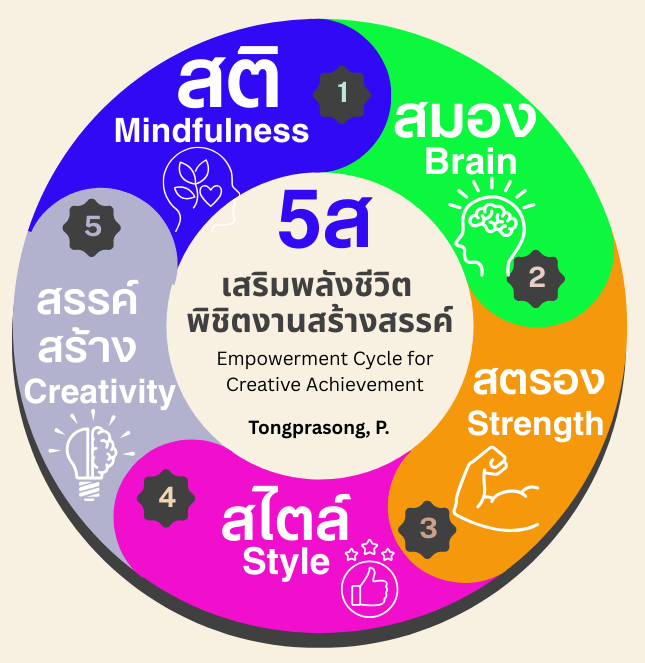
Based on the framework developed by Asst. Prof. Dr. Phorramatpanyaprat Tongprasong
The 5 Key Concepts (5S Framework)
Mindfulness → Brain → Strength → Style → Creativity → Mindfulness (Cycle)
1. Mindfulness
Definition:
The ability to be fully aware of the present moment—internally (thoughts, emotions, feelings) and externally—without judgment and without being dominated by the past or the future.
Key Components: Awareness + Attention + Non-judgmental attitude
2. Brain (Cognitive Function)
Definition:
The organ and central nervous system responsible for processing information, controlling behavior, thinking, learning, and memory. It serves as the main mechanism for reasoning and decision-making.
Key Components: Brain structure + Cognitive processes + Embodied cognition
3. Strength (Resilience)
Definition:
Mental, emotional, and physical robustness, including flexibility in facing challenges and recovering from setbacks (resilience).
Key Components: Endurance + Flexibility + Mental energy
4. Style
Definition:
A distinctive characteristic or pattern of expression that reflects identity, personality, attitude, and taste. This can manifest in thinking, dressing, communication, and lifestyle.
Key Components: Identity + Creativity + Expression
5. Creativity (Innovation)
Definition:
The cognitive and practical process of generating new ideas or improving existing ones to create value and relevance in a changing context.
Key Components: Imagination + Divergent thinking + Implementation
Conceptual Relationship (Cycle)
- Mindfulness → Brain: Mindfulness enhances brain efficiency by reducing distractions and increasing focus.
- Brain → Strength: A well-trained brain that exercises reasoning and emotional control fosters resilience and mental stability.
- Strength → Style: Inner strength empowers individuals to confidently express their authentic style.
- Style → Creativity: A unique and consistent style acts as a driving force for creativity and innovation.
- Creativity → Mindfulness: Sustainable creativity requires mindfulness to evaluate value and impact.
References
Baars, B. J., & Gage, N. M. (2018). Cognition, brain, and consciousness: Introduction to cognitive neuroscience. Academic Press.
Goffman, E. (1959). The presentation of self in everyday life. Anchor Books.
Kabat-Zinn, J. (2015). Mindfulness for beginners: Reclaiming the present moment—and your life. Hachette Books.
Southwick, S. M., & Charney, D. S. (2018). Resilience: The science of mastering life’s greatest challenges. Cambridge University Press.
Sternberg, R. J., & Lubart, T. I. (1999). The concept of creativity: Prospects and paradigms. Handbook of creativity, 3–15.
Tongprasong, P., & Paksa, T. (2025). Innovation in the development of entrepreneurial potential for restaurants in the new normal urban communities of Bangkok. [Unpublished] Research report, Suan Dusit University.
Tongprasong, P., Meekoon, K., Nirunthawee, S., & Wipaporn Puwatanakul. (2024). An Administrative Model for Developing Achievement Oriented and Creative Work of the Ratanakosin Rajabhat University Instructors. MCU Journal of Buddhist Wisdom, 9(4), 133–147.
Tongprasong, P., Meekoon, K., Nirunthawee, S., & Wipaporn Puwatanakul. (2023). An Achievement Oriented work together with Creativity in Work: Key Core Competencies of Rajabahat University. MCU Journal of Buddhist Wisdom, 8(3), 300-311.
Tongprasong, P. (2017). The Use of an Instructional Model Using Service Learning for Enhancing the Consciousness and Awareness in the Ethics and Computer Law Course. ASEAN Journal of Education, 3(1), 89-95.
PT | Empowerment Cycle ปรมัตถ์ปัญปรัชญ์ ต้องประสงค์
Tongprasong, P.
 @Mustland
Leave a comment